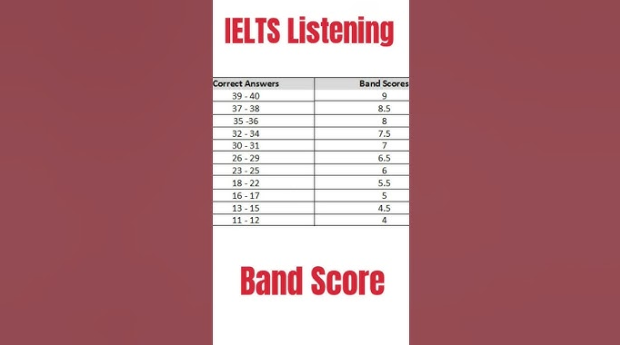
A listening band score shows how well you understand spoken English in a timed exam. It converts your correct answers into a scale that ranges from limited ability to expert control. Because exam forms vary, the conversion adjusts slightly; however, the core scale remains consistent and fair across sessions.
Moreover, the listening band score summarizes multiple micro-skills in one number. It reflects how accurately you catch key facts, track speakers, infer meaning, and separate main ideas from details. Therefore, institutions use it to compare candidates reliably. Additionally, it helps you plan study targets with measurable checkpoints.


Furthermore, the scale supports transparent goal-setting for students and professionals. You can benchmark your current performance, choose resources suited to your level, and monitor steady improvements. Consequently, a single score simplifies admissions, visas, scholarships, and job requirements. Besides, it avoids subjective judgments by relying on standard marking rules.
How the Listening Test Is Scored
Typically, you answer several recordings worth of questions. These include multiple choice, matching, labeling, sentence completion, and short answers. Importantly, every correct answer counts equally. Additionally, spelling and formatting rules matter, so accuracy beats guesswork. Consequently, careful listening and clean writing combine to lift your listening band score significantly.
Examiners design recordings to test real-life listening. You hear varied accents, formal and informal tones, and both monologues and conversations. Therefore, you must follow speakers through changes in direction, numbers, names, and reasons. Moreover, you need to catch synonyms, paraphrases, and signpost words like “however,” “therefore,” and “meanwhile,” which signal turning points.
Because reliability is essential, standardized marking removes personal bias. Although individual items differ in difficulty, raw marks convert to the same scale. Additionally, test makers pretest materials to verify clarity and fairness. Consequently, you receive a stable listening band score that reflects ability rather than luck. Therefore, consistent habits outperform last-minute cramming.
Listening Band Score Conversion Explained
Your raw score is simply the number of correct answers. Then it converts to the scale used for reporting. While different forms can shift conversion slightly, higher raw marks always map to higher bands. Therefore, you can plan targets—such as aiming for a certain number correct—to reach your desired listening band score.
Additionally, bands reflect practical comprehension levels. Lower bands indicate frequent gaps in understanding, especially with speed, accents, and paraphrases. Mid bands show partial control with occasional detail loss. Higher bands signal strong comprehension across contexts, including complex discussions. Consequently, your listening band score offers actionable insight into where to focus next.
Because rounding rules sometimes apply, fractional conversions may become half or whole bands. Therefore, a small raw-score change can push you upward. Moreover, precision matters on borderline ranges. Consequently, proofreading your answers, checking spelling, and following word limits can secure the next step. Besides, calm timing helps you complete every question.
Strategies to Raise Your Listening Band Score
First, train your ear daily with purposeful drills. Use transcripts for shadowing, gap-fills for detail, and summary notes for structure. Additionally, rotate accents and topics to build range. Consequently, you strengthen recognition of paraphrases and signposting. Therefore, your listening band score rises as processing speed and accuracy improve together.
Next, practice active prediction before each section plays. Scan questions, underline keywords, and anticipate synonyms. Furthermore, listen for numbers, names, and contrast markers that often carry answers. Because attention is finite, target what matters most. Consequently, prediction reduces panic and sharpens focus, which directly improves your listening band score over time.
Finally, formalize review after every mock test. Categorize errors: vocabulary, accent, speed, distractors, or spelling. Therefore, design mini-drills around your weakest buckets. Additionally, keep a correction log with examples and fixes. Consequently, you convert mistakes into future points. Besides, repeating this loop builds confidence and durable test-day routines.
Mistakes That Lower a Listening Band Score
Rushing answers without confirming context causes avoidable errors. Moreover, distractors frequently appear immediately before the true answer. Therefore, listen past the first mention of a keyword and confirm the final decision in the audio. Additionally, double-check units, abbreviations, and hyphenation, which often decide outcomes near band boundaries.
Neglecting paraphrases is another common trap. Speakers rarely repeat keywords exactly as printed. Consequently, synonyms and rephrased clauses hide the answer in plain sight. Therefore, train with vocabulary families and collocations. Moreover, practice converting question words into equivalent phrases. Besides, this skill improves comprehension and directly protects your listening band score.
Finally, weak time management leaves blanks. Because every item carries equal weight, you must move forward decisively. Additionally, transfer answers carefully if required, respecting spelling and word limits. Therefore, avoid overthinking one stubborn item. Consequently, you protect points across the set and keep your listening band score trending upward.
Tracking and Interpreting Your Listening Band Score Progress
Design a simple dashboard for weekly measurements. Record raw marks, estimated bands, question-type accuracy, and minutes spent. Moreover, tag each test by accent, topic, and speed. Therefore, you can see patterns clearly. Consequently, targeted drills emerge naturally, and your listening band score climbs with less wasted effort.
Furthermore, use deliberate practice cycles. Set a micro-goal, attempt one focused section, and audit mistakes immediately. Then convert each error into a rule, flashcard, or mini-drill. Consequently, you transform feedback into skill. Besides, short, frequent sessions beat sporadic marathons because memory consolidates better with spaced repetitions and varied inputs.
Finally, simulate test pressure regularly. Replicate timing, transfer steps, and scratch-paper limits. Moreover, test in slightly noisy spaces to harden concentration. Therefore, exam day feels routine rather than threatening. Consequently, composure keeps you accurate when recordings pivot quickly, which preserves valuable points and safeguards your listening band score.
Conclusion
Set a clear target, train prediction and paraphrases, then review errors ruthlessly. Additionally, track progress with a simple dashboard and simulate real pressure weekly. Therefore, you’ll convert practice into points consistently. Ready to level up your listening band score? Start today, follow this roadmap, and claim the result you deserve.
FAQs
How is the listening band score calculated?
Your correct answers become a standardized band using tested conversion rules. Additionally, spelling, capitalization, and word-limit rules apply, so precision matters. Moreover, each item carries equal weight, which rewards consistent accuracy. Consequently, careful listening and clean writing combine to produce a higher, more reliable reported score.
What is a good target listening band score for study or work?
Requirements vary by program and employer, but higher bands open more doors. Therefore, set a target slightly above the minimum to create a safety margin. Additionally, align practice with real recordings matching accents and speeds. Consequently, your preparation becomes relevant, efficient, and clearly measurable across weeks.
How quickly can I raise my listening band score?
Progress depends on baseline, hours invested, and drill quality. Moreover, daily deliberate practice with transcripts accelerates growth. Therefore, combine prediction, paraphrase training, and timed mocks. Consequently, you’ll likely notice early gains in detail recognition, followed by steadier improvements in complex sections and sustained concentration under pressure.
Do accents and speed affect my listening band score?
Yes, variety challenges comprehension more than difficulty alone. Therefore, train with multiple accents and realistic speech rates. Additionally, practice chunking phrases and tracking signpost words to follow turns. Consequently, you reduce shock on exam day and protect points when speakers switch topics, correct themselves, or introduce new details.
What should I do the day before the test?
Keep a light, focused routine. Additionally, run one short warm-up, review your error log, and confirm rules for spelling and formats. Therefore, sleep well, hydrate, and prepare calm breathing cues. Consequently, you’ll manage nerves, maintain focus through all recordings, and convert skills into a confident listening band score.