
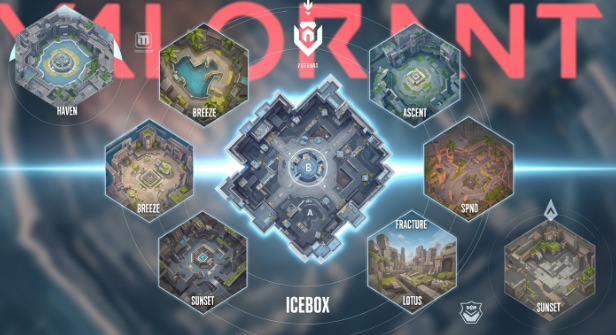
All Valorant Maps is one of the most popular tactical shooters today. Knowing all Valorant maps is essential for improving your gameplay and strategies. Each map has unique features, choke points, and tactical advantages. Understanding these details helps players make better decisions during matches and increases win rates.

Understanding All Valorant Maps
All Valorant maps are designed to challenge players’ teamwork and strategy skills. Maps like Bind, Haven, and Split each have distinct layouts. Learning all Valorant maps allows players to plan attacks, defend sites efficiently, and control critical areas. Map knowledge is the key to mastering movement, rotations, and site control.
Bind Map: Teleports and Tactical Plays
Bind is famous for its teleport system, allowing quick rotations between bomb sites. Knowing all Valorant maps means mastering Bind’s unique layout. Players can use teleport to surprise enemies or rotate swiftly. Understanding sightlines, spike sites, and common hiding spots is crucial to dominate this map.
Haven Map: Triple Site Advantage
Haven stands out among all Valorant maps because it has three bomb sites. Controlling all three sites is challenging but rewarding. Players must communicate constantly, predict enemy movements, and rotate smartly. Mastering Haven improves your ability to handle pressure in complex scenarios.
Split Map: Vertical Battles and Tight Corners
Split is known for its vertical gameplay and narrow pathways. Players familiar with all Valorant maps know Split requires precise positioning and timing. Using ropes, high points, and choke points effectively gives an advantage. Coordinating with teammates and covering sightlines is critical for success.
Ascent Map: Central Control Strategy
Ascent focuses heavily on mid-map control. All Valorant maps have unique dynamics, but Ascent emphasizes controlling the center for tactical advantage. Players can use long sightlines to dominate with rifles or secure rotations. Efficient teamwork and map awareness ensure site control and better outcomes.
Icebox Map: Height and Climbing Advantage
Icebox challenges players with vertical spaces and tight corners. Knowing all Valorant maps ensures players can exploit height advantages and complex routes. Controlling high ground often determines victory. Rotating quickly and predicting enemy positions allows teams to secure bomb sites efficiently.
Breeze Map: Open Areas and Long Sightlines
Breeze is one of all Valorant maps with wide open spaces and long sightlines. Snipers and long-range fights dominate gameplay. Proper communication, crossfires, and map awareness are crucial. Controlling these open areas prevents enemies from pushing sites easily and gives a strategic edge.
Fracture Map: Unique Split Layout
Fracture offers an unusual layout with two spawn points attacking simultaneously. Familiarity with all Valorant maps helps players navigate its complex routes. Quick rotations, strategic pushes, and timing are vital. Teams must adapt constantly to counter enemy strategies and secure victories.
Tips to Master All Valorant Maps
To master all Valorant maps, practice regularly, learn callouts, and study common choke points. Watch high-level gameplay and note how professionals rotate and position themselves. Experiment with different agents and abilities on each map. Constant learning and adaptation lead to consistent improvement and wins.
Conclusion
Knowing all Valorant maps gives players a competitive advantage. Understanding layouts, rotations, and tactical points allows smarter plays and better teamwork. Practice, communication, and map awareness are keys to mastering Valorant. Start applying these strategies today and dominate every match you play.
FAQs
Q1: How many maps are in Valorant?
Valorant has multiple maps, each with unique layouts, including Bind, Haven, Split, Ascent, Icebox, Breeze, and Fracture.
Q2: Which map is best for beginners?
Ascent is beginner-friendly due to its simple layout and fewer complex rotations compared to other maps.
Q3: How can I improve on all Valorant maps?
Practice regularly, learn callouts, watch pro gameplay, and study rotations and choke points for each map.
Q4: Do all maps support all agents?
Yes, but some agents perform better on specific maps due to their abilities and map design.
Q5: Is map knowledge more important than aim?
Both are important, but knowing all Valorant maps allows better positioning, rotations, and team coordination, which often outweighs raw aim.
